
Precision Tube Bending Services

Round tube and pipe from 3/8" to 10" OD — in steel, stainless, aluminum, and specialty alloys.

20+
Bending Machines
~2,000
Die Sets in Inventory
3/8"–10"
OD Range
75+
Years of Experience

Simple Bends to Complex Configurations

Whether it's a single 90° bend or a compound multi-plane configuration, we work directly with OEMs and manufacturers to get it right. Process, material, tolerances. Our engineering team collaborates with yours upfront so there are no surprises on the production floor.

With nearly 2,000 die sets already in inventory, we can skip the weeks-long wait for new tooling that slows down other shops.
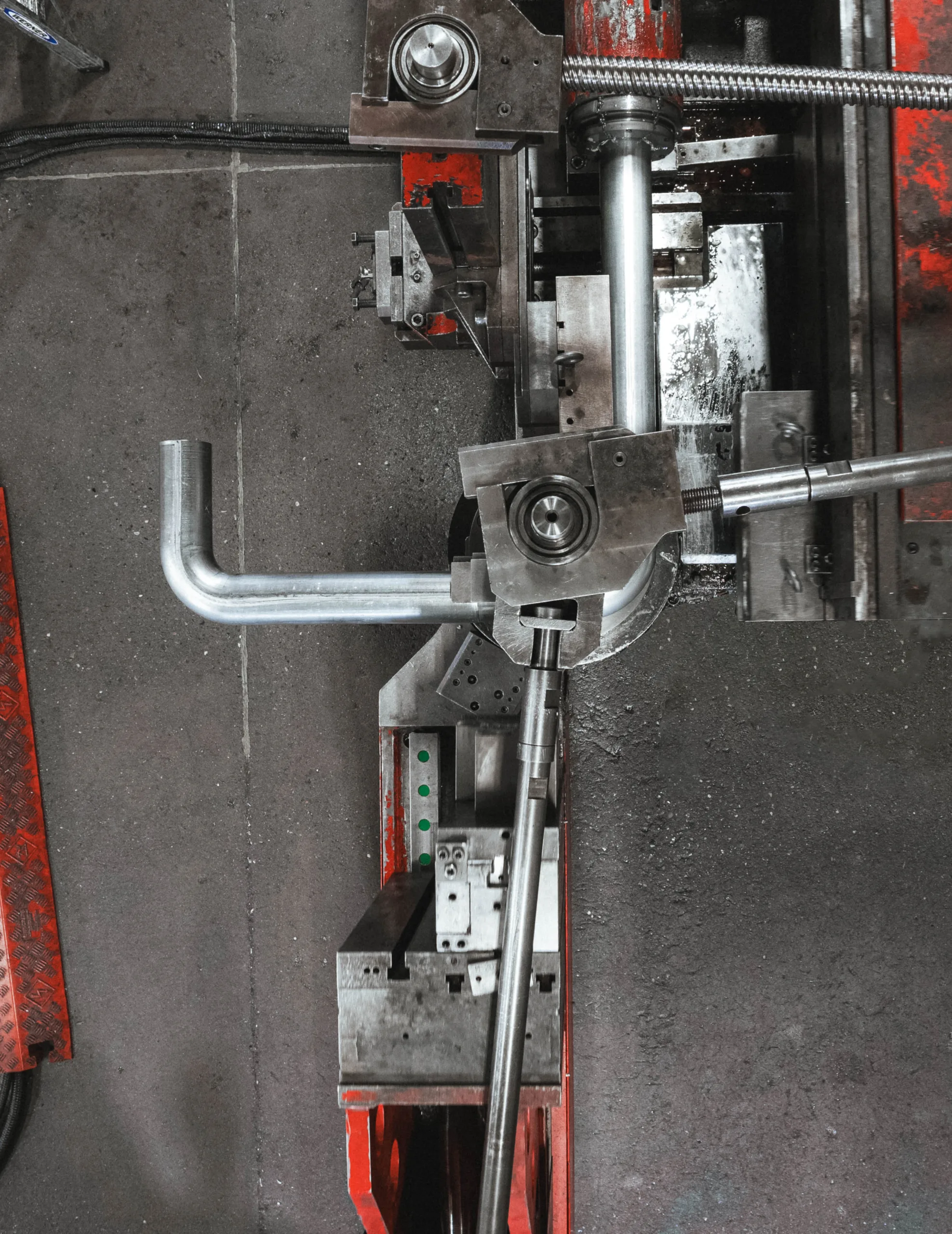
Aerial view of CNC tube bending machine at H-P Products

Over 20 Machines. Send Us Your Specs — We Figure Out the Rest.

Our floor runs both CNC machines for compound, multi-plane bends and NC machines for single-bend applications, covering round tube and pipe from 3/8" to 10" OD. Four of our CNC machines feature stacked die sets, enabling multiple bend radii in a single setup for tighter consistency and reduced setup time.

Non-round profiles (oval, square, rectangular) may be available depending on your application — talk to our engineers.
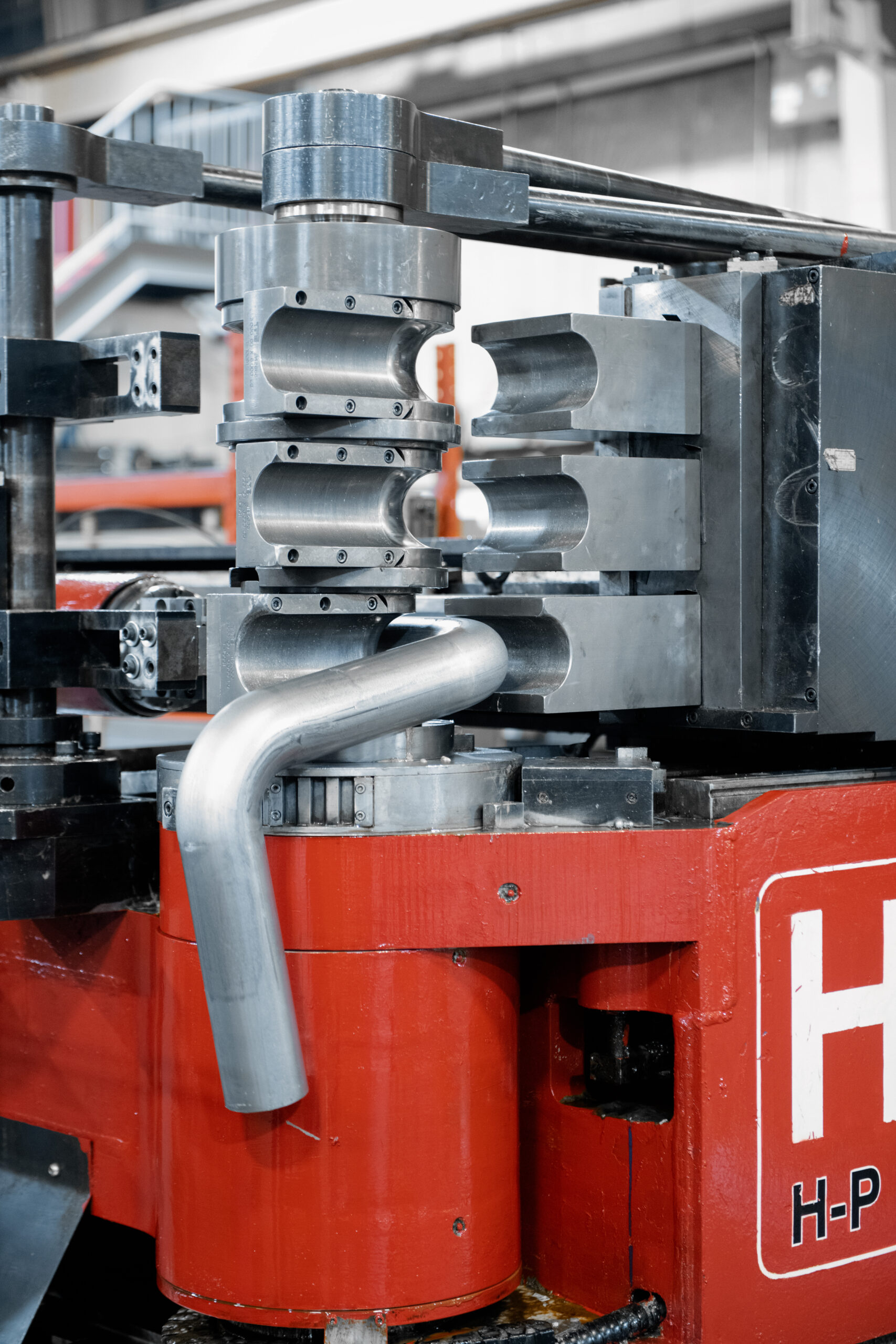
CNC tube bending machine at H-P Products

Materials We Bend

We bend ferrous and non-ferrous metals across a range of grades. Not sure what fits your application? That's what our engineering team is here for.

Carbon Steel 1006 – 1026
Stainless Steel 304, 316, 409, 439
Aluminum 6061, 6063, 5052
Aluminized Steel 1006 – 1010
Specialty Alloys Ask our engineers

Nearly 2,000 Die Sets in Inventory

Nearly 2,000 die sets across a wide range of OD, wall thickness, and CLR combinations. If a setup exists for your part, we can often go straight to production. No lead time burned waiting on new tooling.

What's a 1D bend? A 1D bend has a centerline radius (CLR) equal to the tube's outer diameter. It's the tightest standard radius available. Here are our current 1D tooling sizes:

8 on 8 6 on 6 5 on 5 4.5 on 4.5 4 on 4 3.5 on 3.5 3 on 3 2.75 on 2.75 2.5 on 2.5 2 on 2

Looking for a specific bend setup? Our Bend Die Matrix covers our most common setups. Don't see what you need? Ask us — we may still have it.

Tube Bending FAQ

CNC (Computer Numerical Control) tube bending uses programmable software to control multiple axes, allowing for complex, repeatable bends with tight tolerances. NC (Numerical Control) bending is more manual and typically suited for simpler geometries and shorter runs. In short: CNC bending is best for high precision, complex parts, and repeatability. NC bending works well for simpler bends with lower setup complexity. Most modern production, especially for multi-bend or tight-tolerance parts, relies on CNC bending.
A 1D bend means the centerline radius (CLR) of the bend is equal to the tube's outside diameter (OD). For example, a 2" OD tube with a 2" centerline radius is a 1D bend. These are considered tight-radius bends and require proper tooling and process control to avoid deformation, wrinkling, or flattening.
Centerline radius (CLR) refers to the distance from the center of the bend to the centerline of the tube. It's one of the most important specifications in tube bending because it directly affects bend feasibility, tooling requirements, and material behavior during forming. CLR is typically expressed relative to tube diameter (e.g., 1D, 2D, 3D).
Tube bending can be performed on a wide range of materials, including carbon steel, stainless steel, aluminum, and alloy steels. Material type, wall thickness, and hardness all influence how tight a bend can be achieved and what tooling is required.
Tube bending capabilities vary depending on equipment and tooling. At H-P, we support tube bending from 3/8" up to 10" OD, covering everything from small precision components to large-diameter industrial applications.
A compound bend is a tube with bends in multiple planes, rather than all bends occurring on a single axis. These are commonly used in applications where space constraints or routing complexity require more advanced geometries. Compound bends require precise programming and control to maintain accuracy across multiple bend orientations.
The key difference comes down to how size is measured. Tube is specified by outside diameter (OD) and wall thickness, while pipe is specified by nominal pipe size (NPS) and schedule. Tube bending is typically used for applications requiring tighter tolerances and more precise geometry, while pipe bending is often used in fluid transport systems.
Yes, depending on the project, we can work with customer-supplied material. This is typically evaluated based on material consistency, condition and handling, and compatibility with the bending process. If you're considering supplying material, it's best to review specs with our team upfront to ensure a smooth process.

Complete Your Assembly

Most bent tubes need additional fabrication. We do it all under one roof, so you're not shipping parts between vendors.

Have a Bending Challenge?

Whether it's a simple bend or a complex, multi-plane configuration, we'll get it done right, the first time.