
Every Tube Needs an Ending
Flares, beads, reductions, expansions, and custom geometries. All formed in-house.
A Bad End Form Leaks, Slips, or Fails
The end of the tube is where the connection lives. Where your assembly seals, clamps, or mates to the next component. Get it wrong and you're chasing leaks, reworking joints, or adding hardware that shouldn't be there.
H-P maintains a large inventory of standard end forming tooling and an in-house machine shop that designs and builds custom tooling when off-the-shelf won't cut it. Bending, cutting, forming, and welding all happen under one roof.
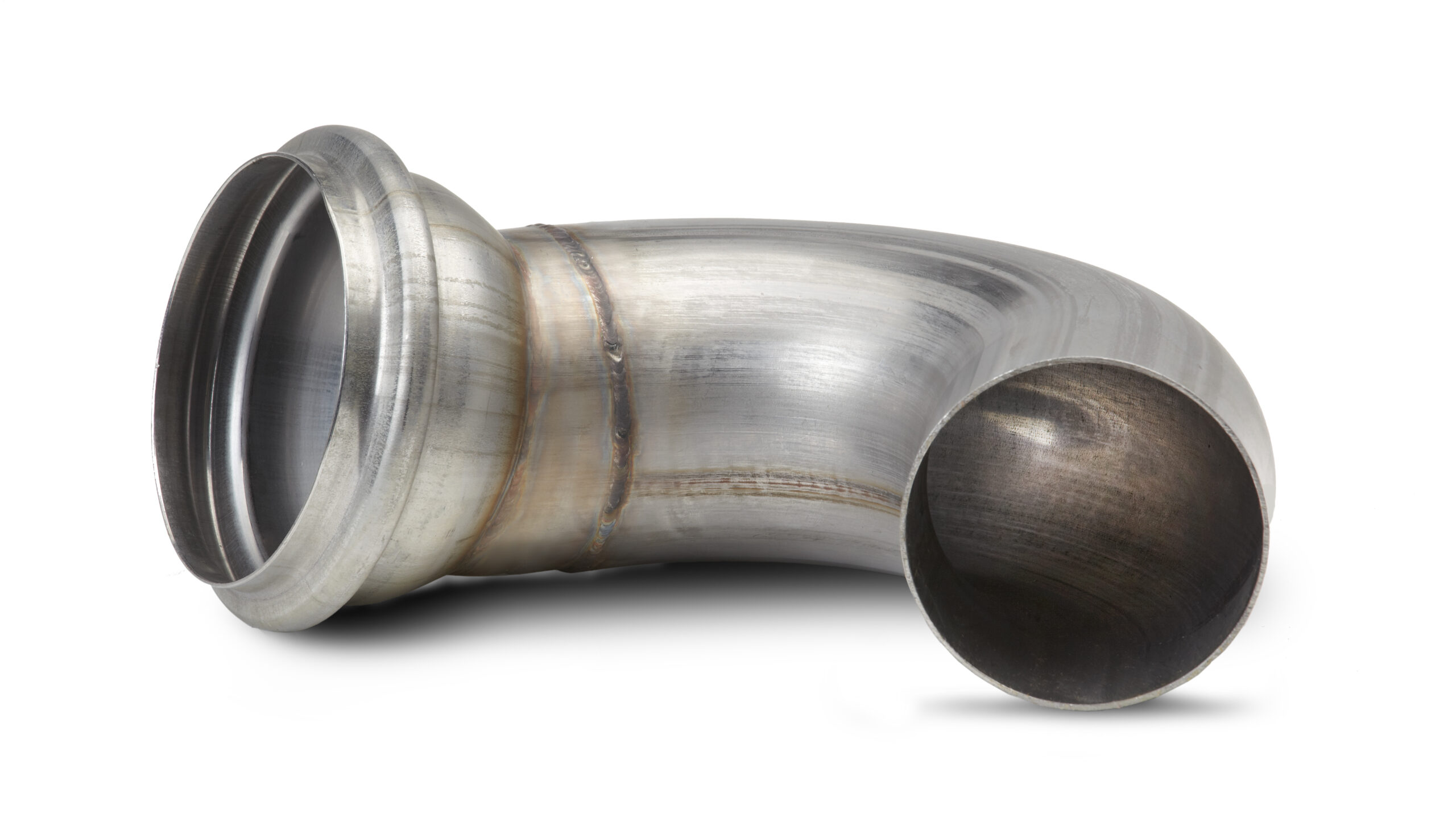
End Form Types
Standard and custom end forms for connection, sealing, and assembly.
| End Form | Description |
|---|---|
| Flares | Conical tube end that mates with fittings or clamp connections. You'll see these everywhere in exhaust and fluid transfer. |
| Spherical Flares | Rounded flare that self-centers during assembly. Better sealing contact than a standard flare on slip-joint connections. |
| Marmon Flares & FlangesPopular | Single and double Marmon profiles designed to mate with V-band clamps. Widely used in exhaust, air intake, and charged air cooling systems. |
| Hose Beads | Raised bead around the tube OD that gives the hose something to grab onto. Keeps clamps from slipping under vibration. |
| Reductions | Steps the tube OD down so it can slip into a smaller-diameter component. Common in telescoping assemblies and transition joints. |
| Expansions | Opens up the tube OD (male or female) to accept a mating tube or fitting. Think telescoping, nesting, or tube-over-tube joints. |
| Straight Attachments | Clean, square-cut end prepped for welding or brazing directly to brackets, flanges, or other components. |
| Flanges | Flat or contoured flange at the tube end for bolted connections, gasket sealing, or structural mounting points. |
| Grooves | Circumferential groove for O-ring seating, snap-ring retention, or coupling engagement. Holds the seal where it needs to be. |
| Slots | Precision slots at the tube end for clamp engagement, alignment keying, or thermal expansion relief. |
| TORCA Slots | Specialized slot pattern designed for TORCA-style ball-and-socket exhaust clamp connections. |
Standard Tooling. Custom Capability.
Two paths to the right end form, both backed by our in-house machine shop and engineering team.
Standard End Forms
Our large inventory of industry-standard tooling covers the most common end form types and sizes. Standard setups mean faster quoting, shorter lead times, and proven repeatability.
Custom End Forms
When standard tooling doesn't fit, our machine shop designs and builds custom end forming tools in-house. Engineering, tooling, prototyping, and production. One roof, one team.
Every weld is a potential failure point. A crack, a leak, a warranty claim. In many cases, a custom end form can replace that weld altogether. Fewer operations, fewer failure modes, lower cost. If your assembly has a welded tube joint, it's worth asking whether forming could do the job instead.
End Forming FAQ
Part of the Full Picture
Have a Connection Problem to Solve?
Send us the print. We'll figure out the end form.